PPionra
Guide
AI Generated: How to Navigate It?
🇫🇷France·Aug 08·4 min read

AI Generated: How to Navigate It?

P
Pionra
@system · 111 views

Date source: 2026-08-06

Close This topic interests you?

Receive an email when an article is published by the editorial team on: Online Services and Digital Training

Add to my alerts

Close This topic has been added to your alerts

You will receive an email when an article is published by the editorial team on: Online Services and Digital Training.

You can unsubscribe at any time in my account > my alerts.

AI Generated: How to Navigate It? Published on August 7, 2026 - Service Public / Directorate for Legal and Administrative Information (Prime Minister)

The European Union is enhancing its protection against artificial intelligence starting from Sunday, August 2, with a European Union regulation ("AI Act") establishing harmonized rules. Service Public informs you.

Illustration

Image 1 Credits: sdecoret - stock.adobe.com

Artificial intelligence (AI) is advancing rapidly, making it increasingly difficult to distinguish between content generated and manipulated by AI and content genuinely created by humans. Regulation (EU) 2024/1689 defines rules by establishing a uniform legal framework, particularly for the development, marketing, deployment, and use of AI systems.

What are the transparency obligations?

This European regulation, among other things, prohibits certain practices, such as using AI to deceive or manipulate you, or to exploit vulnerabilities related to age or disability.

New obligations come into effect on August 2, primarily based on transparency requirements. To achieve this, these contents must be marked with icons created by the EU. Three icons are available for businesses:

  • The basic icon (AI): when AI is used to generate or modify content (text, image, audio, or video);

  • The fully generated by AI icon (AI generated): when the entire content is produced by an AI, without human editorial intervention or creation;

  • The partially modified by AI icon (AI modified): when AI partially transforms existing human content.

These icons will help you, when exposed to this type of content, to clearly and distinctly recognize that these elements are artificially generated or manipulated.

Infographic - AI Icons
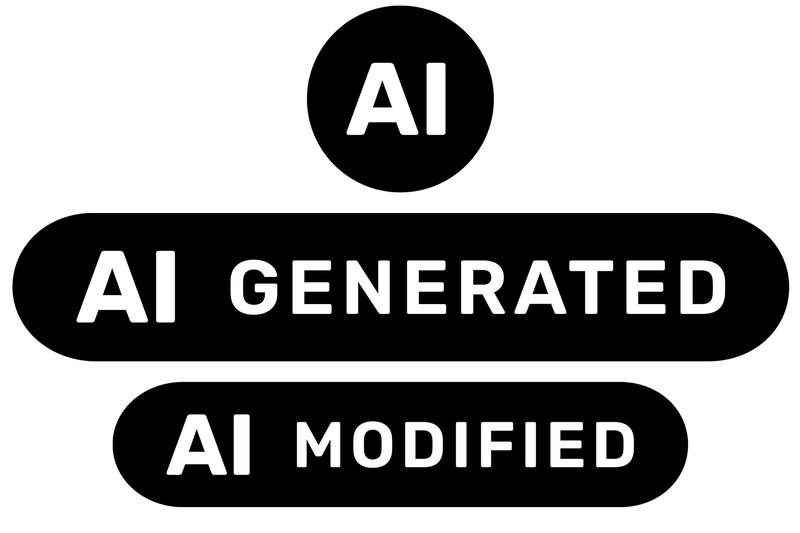
Illustration - AI Icons - more details in the text following the infographic

Illustration Credits: Dila - Service Public

Open the image in a new window

See the text version of the infographic 3 AI icons:

AI generated: generated by AI

AI modified: modified by AI

These new transparency requirements allow you to more easily identify when you are interacting with artificial intelligence or consulting content generated by it, enabling you to make informed choices and better protect yourself against disinformation.

What does the law prohibit specifically?

The AI law prohibits nine practices, including:

  • Harmful manipulation and deception based on AI.

  • Harmful exploitation of vulnerabilities by AI.

  • Evaluation or prediction of individual criminal risk.

  • Unfocused extraction of internet data or video surveillance sequences to create or expand facial recognition databases.

  • Emotion recognition at work and in educational institutions.

  • Biometric categorization to deduce certain protected characteristics.

  • Real-time remote biometric identification for public order maintenance in public spaces.

  • AI systems that generate non-consensual sexually explicit and intimate content or child sexual abuse material (CSAM), such as AI-based "nudification" applications, this prohibition will take effect in December 2026.

Additional AI rules will take effect from 2027: a set of specific provisions to regulate high-risk AI (operating in sensitive areas such as health or security). Their entry into force has been recently delayed to give companies time to prepare.

What are the penalties?

National market surveillance authorities, the European Office for AI, and the European Data Protection Supervisor are responsible for enforcing transparency rules and can impose fines:

  • up to 15 million euros, or 3% of the global annual turnover, for companies;

  • up to 750,000 euros for EU institutions, bodies, and agencies;

  • taking into account proportionality for small and medium-sized enterprises (SMEs).

These provisions will be phased in, with different obligations taking effect at different dates.

Agenda

See all deadlines

Have a comment?

Source: Service-Public individuals

The first 30 days in France — the complete guide

Every step in order, with the deadlines. Free, in one email.

Similar posts

Home🇫🇷FranceCategoryGuideAI Generated: How to Navigate It?
AI Generated: How to Navigate It?
GuidePaperwork🇫🇷 France

AI Generated: How to Navigate It?

P
French community
Pionra
📖 4 min read👁 111 views
🇫🇷
Share
Source officielle : service-public-particuliers

Date source: 2026-08-06

Close This topic interests you?

Receive an email when an article is published by the editorial team on: Online Services and Digital Training

Add to my alerts

Close This topic has been added to your alerts

You will receive an email when an article is published by the editorial team on: Online Services and Digital Training.

You can unsubscribe at any time in my account > my alerts.

AI Generated: How to Navigate It? Published on August 7, 2026 - Service Public / Directorate for Legal and Administrative Information (Prime Minister)

The European Union is enhancing its protection against artificial intelligence starting from Sunday, August 2, with a European Union regulation ("AI Act") establishing harmonized rules. Service Public informs you.

Illustration

Image 1 Credits: sdecoret - stock.adobe.com

Artificial intelligence (AI) is advancing rapidly, making it increasingly difficult to distinguish between content generated and manipulated by AI and content genuinely created by humans. Regulation (EU) 2024/1689 defines rules by establishing a uniform legal framework, particularly for the development, marketing, deployment, and use of AI systems.

What are the transparency obligations?

This European regulation, among other things, prohibits certain practices, such as using AI to deceive or manipulate you, or to exploit vulnerabilities related to age or disability.

New obligations come into effect on August 2, primarily based on transparency requirements. To achieve this, these contents must be marked with icons created by the EU. Three icons are available for businesses:

  • The basic icon (AI): when AI is used to generate or modify content (text, image, audio, or video);

  • The fully generated by AI icon (AI generated): when the entire content is produced by an AI, without human editorial intervention or creation;

  • The partially modified by AI icon (AI modified): when AI partially transforms existing human content.

These icons will help you, when exposed to this type of content, to clearly and distinctly recognize that these elements are artificially generated or manipulated.

Infographic - AI Icons

Illustration - AI Icons - more details in the text following the infographic

Illustration Credits: Dila - Service Public

Open the image in a new window

See the text version of the infographic 3 AI icons:

AI generated: generated by AI

AI modified: modified by AI

These new transparency requirements allow you to more easily identify when you are interacting with artificial intelligence or consulting content generated by it, enabling you to make informed choices and better protect yourself against disinformation.

What does the law prohibit specifically?

The AI law prohibits nine practices, including:

  • Harmful manipulation and deception based on AI.

  • Harmful exploitation of vulnerabilities by AI.

  • Evaluation or prediction of individual criminal risk.

  • Unfocused extraction of internet data or video surveillance sequences to create or expand facial recognition databases.

  • Emotion recognition at work and in educational institutions.

  • Biometric categorization to deduce certain protected characteristics.

  • Real-time remote biometric identification for public order maintenance in public spaces.

  • AI systems that generate non-consensual sexually explicit and intimate content or child sexual abuse material (CSAM), such as AI-based "nudification" applications, this prohibition will take effect in December 2026.

Additional AI rules will take effect from 2027: a set of specific provisions to regulate high-risk AI (operating in sensitive areas such as health or security). Their entry into force has been recently delayed to give companies time to prepare.

What are the penalties?

National market surveillance authorities, the European Office for AI, and the European Data Protection Supervisor are responsible for enforcing transparency rules and can impose fines:

  • up to 15 million euros, or 3% of the global annual turnover, for companies;

  • up to 750,000 euros for EU institutions, bodies, and agencies;

  • taking into account proportionality for small and medium-sized enterprises (SMEs).

These provisions will be phased in, with different obligations taking effect at different dates.

Agenda

See all deadlines

Have a comment?

Source: Service-Public individuals

💬 0

The first 30 days in France — the complete guide

Every step in order, with the deadlines. Free, in one email.

Related guides